Fleder
When a giant bat feeds of the blood of the dead on desecrated ground, or directly from the veins of a higher vampire it can turn into a Fleder.
Motives & Tactics: Savage Killer, Death from Above, Terror of the Squalor
When a giant bat feeds of the blood of the dead on desecrated ground, or directly from the veins of a higher vampire it can turn into a Fleder.
Common people believe that fleders are dead heathens who turned into vampires and rose from their graves. Being vampires, they attack sleeping people and drink their blood. According to peasants, a man bitten by a fleder becomes a fleder himself. This is nonsense, obviously, for towns would be completely infested by them after only a few weeks due to the creature’s ravenous appetite.
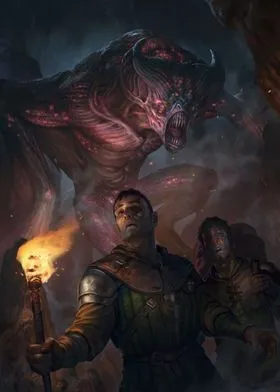
The fleder is a lesser vampire. Its appetite for blood is the only thing it shares with the noble princes of the night. A creature with animal instincts, deprived of any humanity, it can mutilate its victims terribly. Its head — triangular, with a flat face and horn-like protrusions with certain bat-like features, including the creature’s face and ears — renders it similar to other animalistic vampires, such as garkain or ekimmara. With its glowing red eyes the fleder also resembles a demon and inspires terror in the heart of peasants and city folks alike.
The fleder is not a good flier, the membranes under its arms allowing only short jumps and attacks from above. Though not particularly smart, it knows that it gains an advantage and increases its chance of victory by suddenly attacking unsuspecting victims. The long, prehensile toes on the beast’s feet allow it to hang head down from the ceiling, one of its favorite method to ambush a prey. Fleders are terrified of sunlight and will avoid it at all cost. While it is true that they don’t turn to ash while exposed to it like other vampires do, they are still significantly weaker when expose to direct sunlight, be it natural or magical. They are otherwise unaffected by the current time of the day but tend to slumber during daylight hours.
Fleder usually hunt in rundown city districts, especially where buildings are high and cramped, allowing the creature to use its agility to escape after a bloody meal. They are clever enough to recognize an inebriated prey, hunting near taverns to feed on unwary town drunks. Fleder are usually lone, nocturnal hunters, but in large cities, where they can cover a huge hunting ground, it can happen that a brood of this creatures band together. They then pick a common nest to rest during the day, often an abandoned church tower or an old windmill. They are also found in the wilderness, usually near cliffs and rugged, hilly lands where they can easily hide.
The fleder can climb difficult surfaces, including upside down on ceilings.
While in sunlight the Fleder is Vulnerable.
Spend a Fear: If the fleder jumps at to a position in Close range to land to a creature in Melee range and attacks it, that target must make a Strength Reaction Roll (13). If it fails, it becomes Vulnerable until after the next move by the Fleder and the DM gains 1 Fear.
Spend a Fear: If the Fleder has grappled a target, the Fleder can do an attack role against that target with advantage. If the Fleder succeeds, the Fleder also gains the amount of HP that it did as damage.
Mark a Stress: The Fleder tries to grapple a creature within Very Close range. The target must make a Strength Reaction Roll (13) to avoid being grappled.
Tier 2 skulk
When a giant bat feeds of the blood of the dead on desecrated ground, or directly from the veins of a higher vampire it can turn into a Fleder.
Motives & Tactics: Savage Killer, Death from Above, Terror of the Squalor
Difficulty: 13 | Thresholds: 8/18 | HP: 5 | Stress: 3
ATK: +4 | Claws: Melee | 2d6+3 Physical
Experience: Echolocation +2
HP:
STRESS:
When a giant bat feeds of the blood of the dead on desecrated ground, or directly from the veins of a higher vampire it can turn into a Fleder.
Motives & Tactics: Savage Killer, Death from Above, Terror of the Squalor
Common people believe that fleders are dead heathens who turned into vampires and rose from their graves. Being vampires, they attack sleeping people and drink their blood. According to peasants, a man bitten by a fleder becomes a fleder himself. This is nonsense, obviously, for towns would be completely infested by them after only a few weeks due to the creature’s ravenous appetite.
The fleder is a lesser vampire. Its appetite for blood is the only thing it shares with the noble princes of the night. A creature with animal instincts, deprived of any humanity, it can mutilate its victims terribly. Its head — triangular, with a flat face and horn-like protrusions with certain bat-like features, including the creature’s face and ears — renders it similar to other animalistic vampires, such as garkain or ekimmara. With its glowing red eyes the fleder also resembles a demon and inspires terror in the heart of peasants and city folks alike.
The fleder is not a good flier, the membranes under its arms allowing only short jumps and attacks from above. Though not particularly smart, it knows that it gains an advantage and increases its chance of victory by suddenly attacking unsuspecting victims. The long, prehensile toes on the beast’s feet allow it to hang head down from the ceiling, one of its favorite method to ambush a prey. Fleders are terrified of sunlight and will avoid it at all cost. While it is true that they don’t turn to ash while exposed to it like other vampires do, they are still significantly weaker when expose to direct sunlight, be it natural or magical. They are otherwise unaffected by the current time of the day but tend to slumber during daylight hours.
Fleder usually hunt in rundown city districts, especially where buildings are high and cramped, allowing the creature to use its agility to escape after a bloody meal. They are clever enough to recognize an inebriated prey, hunting near taverns to feed on unwary town drunks. Fleder are usually lone, nocturnal hunters, but in large cities, where they can cover a huge hunting ground, it can happen that a brood of this creatures band together. They then pick a common nest to rest during the day, often an abandoned church tower or an old windmill. They are also found in the wilderness, usually near cliffs and rugged, hilly lands where they can easily hide.
—
—
—
—
No subclasses available.
Answer any of the following, or create your own.
—
Ask one of the following, or improvise.
—
Be thoughtful and kind.
Remember to be respectful. Comments are moderated and should add to the discussion.